AlUla Stargazing Guide: Best Spots, Tips & What You'll See in the Desert Sky
There are few places on Earth where the night sky reveals itself with such breathtaking clarity as in the deserts surrounding AlUla. With virtually zero light pollution, dry atmospheric conditions, and clear skies for most of the year, AlUla has earned its reputation as one of the premier stargazing destinations in the world. This guide will help you make the most of this celestial experience.
Why AlUla is Perfect for Stargazing
Several factors combine to make AlUla's night sky exceptional:
Minimal light pollution: AlUla's remote desert location, far from major cities, means the sky is remarkably dark. On the Bortle Dark-Sky Scale (which measures light pollution from 1 to 9), AlUla's desert areas rate around 2-3, compared to 7-8 for typical urban areas. This means you can see celestial objects that are completely invisible from cities.
Dry atmosphere: The desert climate means very low humidity, which reduces atmospheric distortion and allows for sharper views of stars, planets, and deep-sky objects. The air is remarkably transparent.
High elevation: At approximately 650 meters above sea level, AlUla sits above some of the denser lower atmosphere, providing slightly better seeing conditions than sea-level locations.
Clear skies: AlUla enjoys over 300 clear nights per year, giving you excellent odds of a successful stargazing session regardless of when you visit.
Best Stargazing Spots in AlUla
1. Gharameel
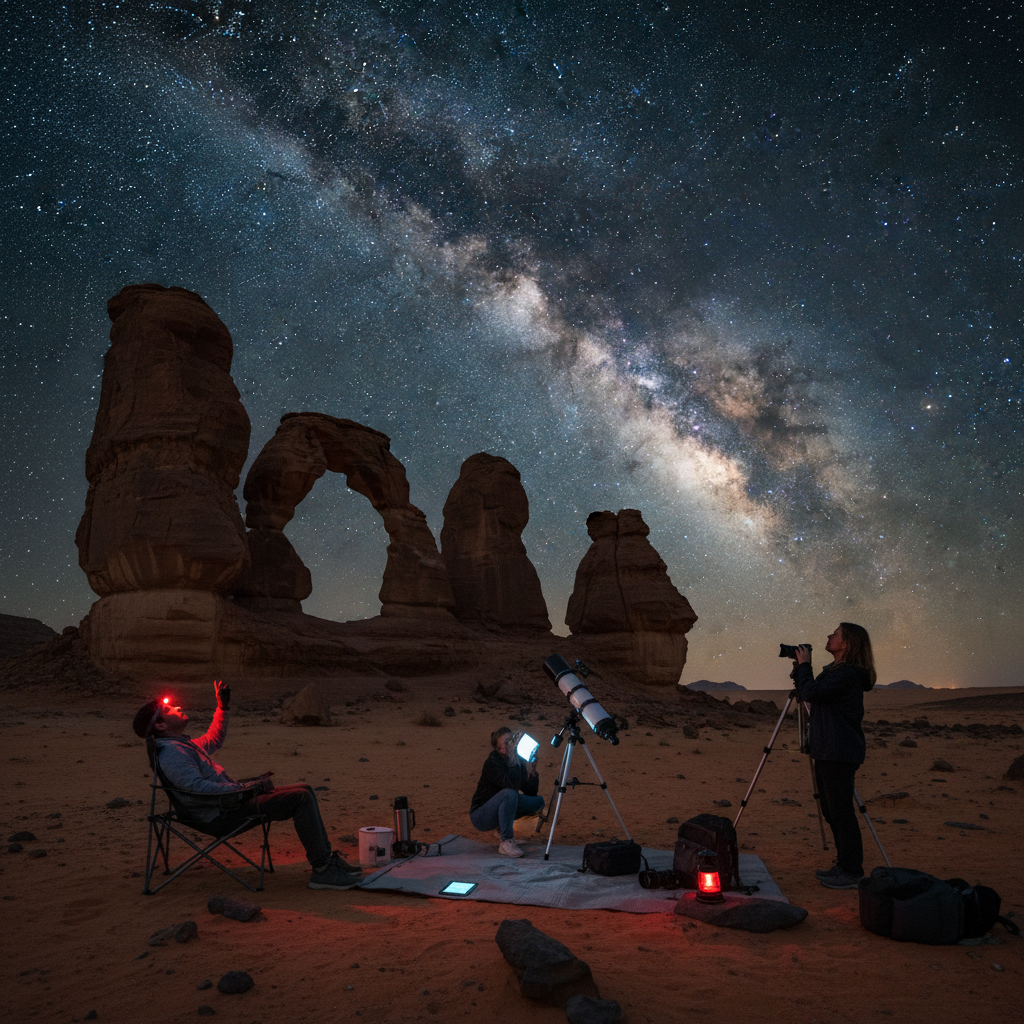
The premier stargazing location in AlUla, Gharameel features otherworldly rock formations that create a dramatic foreground for night sky photography. During the AlUla Skies Festival (winter season), organized stargazing events are held here with professional telescopes and expert astronomers.
2. The Desert Beyond Elephant Rock
The open desert area beyond Elephant Rock offers unobstructed 360-degree views of the sky. The iconic rock formation also makes for stunning foreground in astrophotography compositions.
3. Harrat Uwayrid
The volcanic plateau (harrat) east of AlUla offers elevated viewpoints with minimal terrain obstruction. The dark basalt landscape provides excellent contrast for night sky viewing.
4. Remote Desert Camps
Several glamping and camping operators set up sites in remote desert locations specifically chosen for their dark sky conditions. These often include stargazing as part of the overnight experience.
What You'll See in AlUla's Sky
The Milky Way
The most spectacular sight in AlUla's night sky is our own galaxy, the Milky Way. Visible as a luminous band stretching across the entire sky, the Milky Way's core (visible from March to October) is particularly stunning, revealing intricate dust lanes, star clouds, and nebulae that are invisible from light-polluted areas.
Planets
Depending on the time of year, you may see several planets with the naked eye:
- Venus: The brightest object in the sky after the Moon, visible as the "evening star" or "morning star"
- Jupiter: Bright and steady, with its four largest moons visible through binoculars
- Saturn: Its rings are visible through even a small telescope
- Mars: Distinctive red-orange color, especially bright during opposition years
Deep-Sky Objects
With the naked eye or binoculars, you can spot:
- The Andromeda Galaxy (M31): The nearest major galaxy to our own, visible as a fuzzy patch
- The Orion Nebula (M42): A stellar nursery visible in Orion's sword
- The Pleiades (M45): A stunning open star cluster, also known as the Seven Sisters
- The Double Cluster in Perseus: Two adjacent star clusters visible to the naked eye
Meteor Showers
AlUla is an exceptional location for watching meteor showers. Key dates:
| Shower | Peak Date | Rate (per hour) |
|---|---|---|
| Quadrantids | January 3-4 | 120 |
| Perseids | August 12-13 | 100 |
| Geminids | December 13-14 | 150 |
| Orionids | October 21-22 | 20 |
Tips for the Best Stargazing Experience
Timing
- Best months: October through March (cooler temperatures, earlier sunset)
- Moon phase: Plan around the new moon for the darkest skies. The week before and after the new moon is ideal.
- Time of night: The sky is darkest between 10 PM and 3 AM, after astronomical twilight ends
What to Bring
- Warm clothing: Desert temperatures drop significantly at night, often to 5-10°C in winter. Bring layers, a warm jacket, hat, and gloves.
- Red flashlight: Preserves your night vision (white light destroys dark adaptation for 20-30 minutes)
- Blanket or mat: For comfortable lying-down viewing
- Binoculars: Even basic 7x50 or 10x50 binoculars dramatically enhance the experience
- Star chart app: Apps like Stellarium or Sky Guide help identify what you are seeing
Photography Tips
- Use a tripod: Essential for any night sky photography
- Wide-angle lens: f/2.8 or wider is ideal
- Settings: Start with ISO 3200, 20-second exposure, widest aperture
- Focus: Use live view to manually focus on a bright star
- Include foreground: AlUla's rock formations make incredible foreground elements
Dark Adaptation
Your eyes take approximately 20-30 minutes to fully adapt to darkness. Avoid looking at phone screens (or use red filter mode) during this period. Once adapted, you will be amazed at how many more stars become visible.
Organized Stargazing Experiences
AlUla Skies Festival (Seasonal)
During the winter season, the AlUla Skies Festival offers organized stargazing events at Gharameel with professional-grade telescopes, expert astronomers, and comfortable seating areas. Tickets are available through Experience AlUla.
Osour.sa Stargazing Packages
Our Adventure Explorer and Luxury Retreat packages include dedicated stargazing sessions with professional equipment and guides. We can also arrange private stargazing experiences for groups.
Desert Camping with Stargazing
Several of our packages combine desert camping with stargazing for the ultimate overnight experience. There is nothing quite like falling asleep under the Milky Way in the AlUla desert.
The night sky over AlUla is a natural wonder that rivals any of its archaeological treasures. Whether you are an experienced astronomer or simply someone who wants to see the Milky Way for the first time, AlUla's desert sky will leave you speechless. Contact us to include stargazing in your AlUla itinerary.